Fundamentals of Financial Literacy: Grades 5–7 (Test Set)
- Price in currencies:
- 22.92 $ · 1848 RUB · 20.47 €
- Category:
- School Textbooks
- Item:
- ФГ 5-7км.pdf (868.4 KB)
- Uploaded:
- 09.10.2026 2:01:37
- Sales:
- 0
- Refunds:
- 0
- Seller:
- Kontrosha · about the seller and their products
DESCRIPTION
Fundamentals of Financial Literacy: Grades 5–7 (Test Set)
This set of tests on the fundamentals of financial literacy for grades 5–7 is aligned precisely with the corresponding sections and chapters of the 2026 textbook *Fundamentals of Financial Literacy: Financial Culture* by V.E. Zuev. It comprises 31 section-based tests and 6 comprehensive chapter tests.
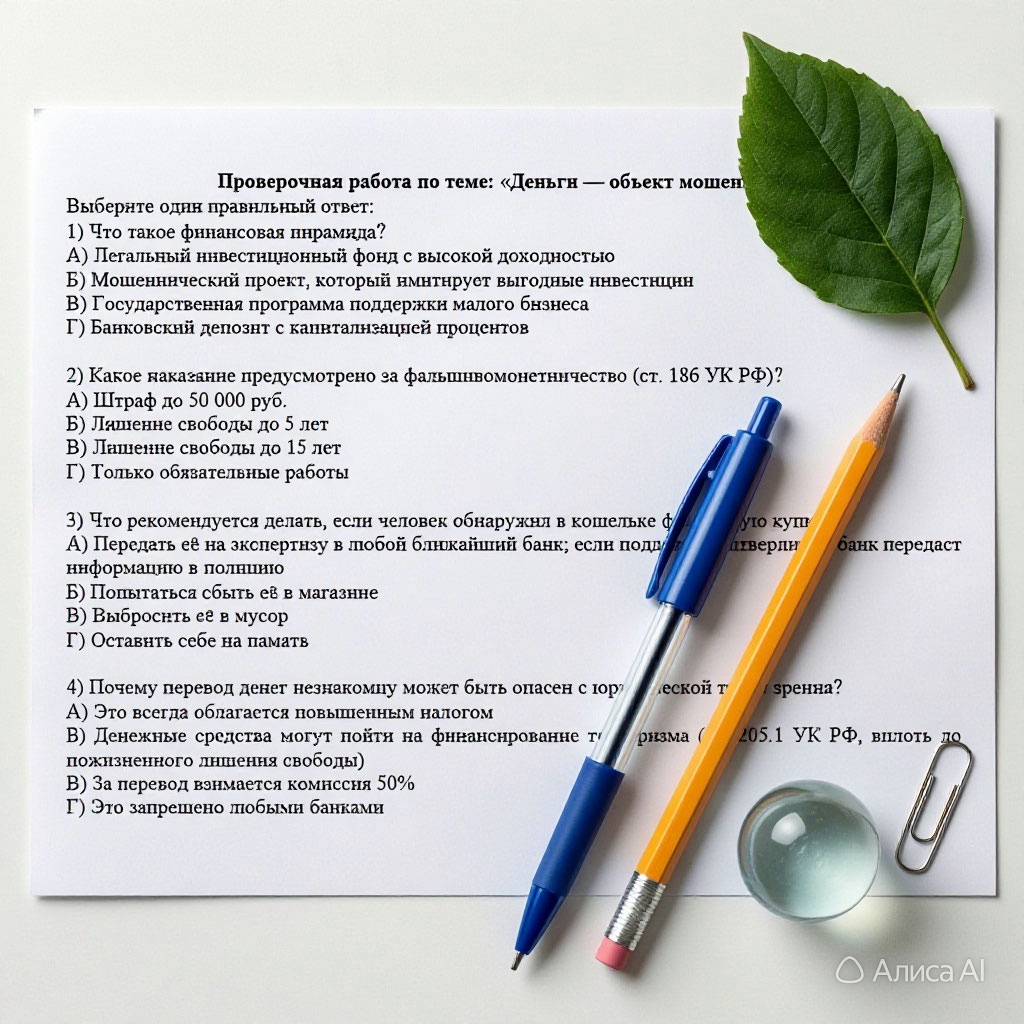
The tests are designed to assess student knowledge and can be used for both ongoing and summative evaluation. Each test consists of 15 multiple-choice questions (with one correct answer out of four). All questions are based strictly on the text of the relevant textbook chapter. Answer keys and grading criteria are provided for all tasks.
Key advantages of this resource include its strict alignment with the textbook, time savings for teachers, and the development of student skills. It is suitable for thematic assessment after studying a section, exam preparation, independent study with self-checking, and remote learning (it is easily converted to an online format). The target audience includes teachers, curriculum specialists, tutors, and middle school students. The materials are provided in Word format.
The set covers the following topics:
Chapter 1: Money and Society
1. Money and Its Functions
2. Why Does Money Lose Value?
Chapter 2: Planning and Personal Money
3. Human Activity and Money
4. Personal and Family Budgets
5. Budget Income
6. Can Income Be Illegal?
7. Expenses: Where Does Personal Budget Money Go?
8. How Does Money Instill Discipline?
9. Money and Helping Others
Chapter 3: Money and Responsibility
10–11. Individuals and Financial Decisions
12. Assets and Property
13. Money and Risk
14. Money and Work
15. How Can a Teenager Save Money?
16. How to Learn to Save?
17. Responsible Consumption
Chapter 4. Work, Entrepreneurship, and Money
18. Work as an Economic Phenomenon
19. Work, Income, and Taxes
20. Who Can Be an Entrepreneur?
21. Entrepreneurial Finances
22. Teenagers and Future Careers
Chapter 5. Money, Climate, and Daily Life
23. Climate and Expenses
24. The Home We Live In
25. Health and Nutrition
Chapter 6. The Consumer, Financial Instruments, and Services
26. Money and Needs
27–28. I Consume! I Pay!
29. Where Is Money Traded?
30. Financial Institutions and Competition
31. Instruments and Services: What Is the Difference?
32. The Consumer of Financial Services
33. What Kind of Money Do Consumers Use?
Check out other assignments for this program on the author´s page.
REVIEWS
Reviews: (0)
No customer reviews yet.