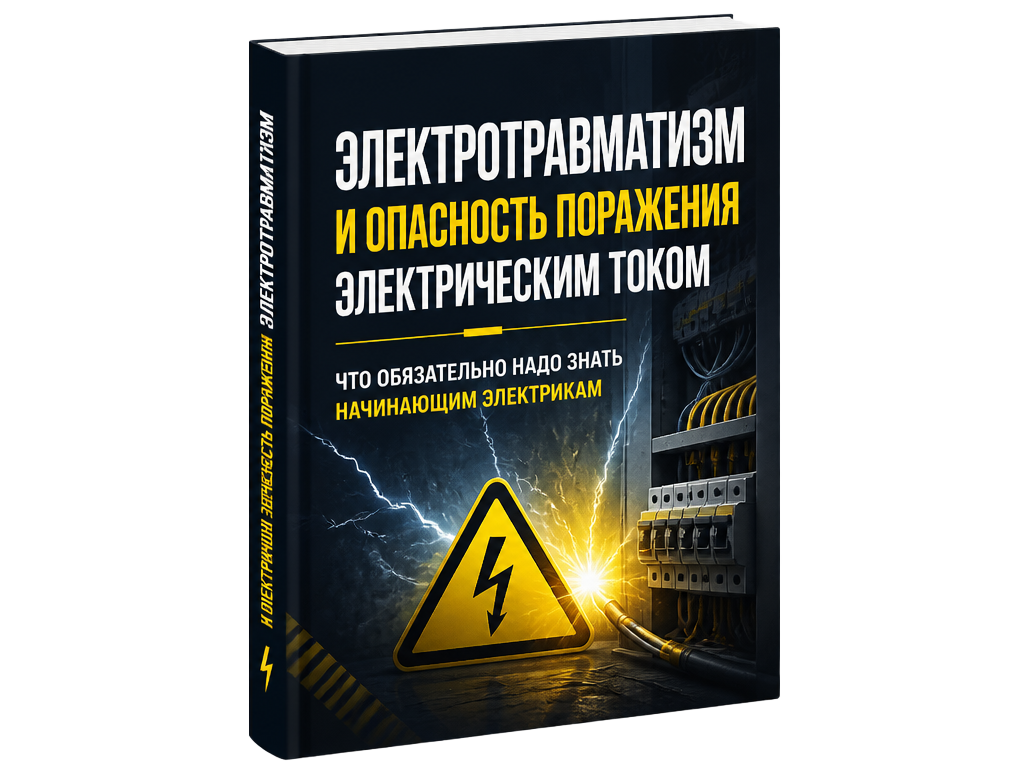
Electrical Injuries and the Danger of Electric Shock. A Practical Guide
- Price in currencies:
- 2.33 $ · 196 RUB · 2.08 €
- Category:
- For Education Students
- Item:
- Электротравматизм и опасность поражения электрическим током.pdf (1564.11 KB)
- Uploaded:
- 30.07.2026 18:07:14
- Sales:
- -1
- Refunds:
- -1
- Seller:
- vida78 · about the seller and their products
DESCRIPTION
Electrical Injuries and the Danger of Electric Shock. A Practical Guide
Electrical energy is the foundation of modern industry, transport, and daily life. But for all its benefits, it remains a source of great danger. Electric shock is one of the most severe and insidious types of injuries, because electric current has no external signs – it cannot be seen, heard, or felt in advance. Danger may be hidden in equipment that appears to be in good working order, and the consequences of a shock can be sudden and fatal.
This practical guide addresses the most important topic in working with electrical installations — safety of life and health. It covers in detail:
causes of occupational electrical injuries and typical accident scenarios;
mechanisms of electric current effects on the human body (thermal, electrolytic, biological);
types of electrical injuries: local and general, electric burns, electrical marks, skin metallization, electroophthalmia, electric shock, cardiac fibrillation;
factors affecting the outcome: body resistance, current magnitude, voltage, frequency, current path, duration, individual characteristics, environmental conditions;
touch and step voltages – what they are and how they occur;
classification of premises and electrical installations by hazard level;
comprehensive protection measures: insulation, enclosures, extra-low voltage, protective earthing, automatic disconnection, potential equalisation, electrical separation, insulating rooms, organisational measures, personal protective equipment;
design of earthing systems, requirements for electrodes and conductors;
first aid algorithm for electrical injuries: release from current, artificial respiration, chest compressions, basic life support.
The book is written in clear language and includes diagrams, calculation formulas, and practical recommendations. It is useful for:
students of technical universities and colleges studying occupational safety, electrical safety, and operation of electrical installations;
trainee electricians, power engineers, and automation specialists;
teachers for course preparation and safety briefings;
anyone who works with electrical equipment and wants to understand the risks.
Knowledge of electrical safety fundamentals is not a formality – it is a condition for survival. This guide will help you approach any work with electricity consciously, avoid dangerous situations, and act correctly in emergencies.
Additional information:
Introduction – relevance of the problem, objectives of the guide.
Electrical Injuries – statistics, causes (technical, organisational, social), direct and indirect contact.
Types of Electrical Injuries – local (burns, marks, metallisation, mechanical damage, electroophthalmia) and general (electric shock, fibrillation, shock).
Touch and Step Voltages – definition, calculation, current spreading zones, potential equalisation.
Factors Affecting the Outcome – body resistance, current, voltage, frequency, path, duration, individual characteristics, environment, neutral mode, soil resistivity.
Classification of Electrical Installations and Premises – by voltage, neutral mode, hazard level (non-hazardous, increased hazard, especially hazardous).
First Aid for Victims – release from current, condition assessment, artificial respiration, chest compressions, resuscitation algorithm.
Hazard Analysis of Electrical Installations – two-phase and single-phase contact, networks with earthed and isolated neutral, calculation formulas.
Protective Measures – classification, insulation, enclosures, extra-low voltage, protective earthing, automatic disconnection, potential equalisation, circuit separation, organisational measures, PPE.
Earthing System Design – types of earth electrodes, requirements, installation, certification, connection diagrams.
Conclusion and Further Study Recommendations – what to study next, learning sequence, references.
REVIEWS
Reviews: (0)
No customer reviews yet.