 Discount for regular customers! If the total of your purchases from the seller
TerMaster
exceeds:
Discount for regular customers! If the total of your purchases from the seller
TerMaster
exceeds:
- $250 discount 15%
- $50 discount 10%
- $30 discount 7%
- $15 discount 5%
- $5 discount 3%
- $3 discount 2%
- $1 discount 1%

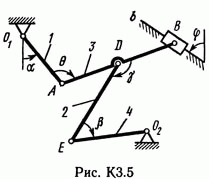
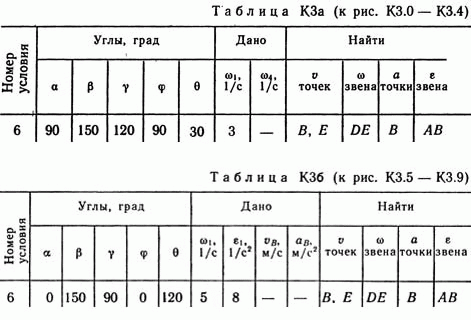
The solution of control K3 Fig 5 srv 6 (option 56) Targ
Right after the payment you receive a link to the archive with the solution of the problem in theoretical mechanics K3 V56 (figure 5 the condition 6) of manuals Targ SM 1989 for part-time students of engineering, construction, transport, instrument-specialties of higher education. The task is made in the format word, packed to the archive zip.
Solution of the K3 task Option 56. Task: The flat mechanism consists of rods 1, 2, 3, 4 and the slider B or E (Fig. KZ.0 - K3.7) or of rods 1, 2, 3 and the sliders B and E ( Fig. K3.8, K3.9) connected to each other and to the fixed supports O1, O2 by hinges; point D is in the middle of rod AB. The lengths of the rods are respectively l1 = 0.4 m, l1 = 1.2 m, l3 = 1.4 m, l4 = 0.6 m. The position of the mechanism is determined by the angles α, β, γ, φ, θ. The values of these angles and other specified values are shown in table. KZa (for Fig. 0-4) or in table. KZB (for Fig. 5-9); while in the table. KZa ω1 and ω4 are constant values. Determine the values indicated in the tables in the “Find” columns. The arc arrows in the figures show how, when constructing a drawing of the mechanism, the corresponding angles should be laid down: clockwise or counterclockwise (for example, the angle γ in Fig. 8 should be postponed from DB clockwise, and in Fig. 9, counterclockwise arrows, etc.). The construction of the drawing begins with a rod whose direction is determined by the angle α; for greater clarity, depict the slider with guides as in the KZ example (see Fig. KZb). Given angular velocity and angular acceleration, consider counter-clockwise, and given velocity vB and acceleration aB from point B to b (Fig. 5-9).
If you liked the solution and you successfully passed it, please leave a positive review.
Thanks.
No customer reviews yet.
Discount for regular customers! If the total of your purchases from the seller
TerMaster
exceeds: